Sad Bunny Feelings Quote – Mental Health Graphics
First Impression: Soft, Sincere, and Surprisingly Versatile
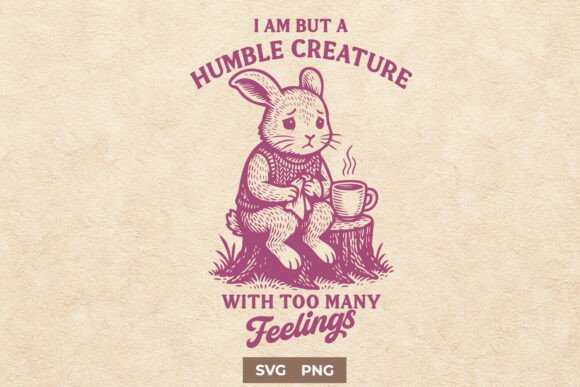
When I opened Sad Bunny Feelings Quote – Mental Health, my immediate reaction wasn’t “cute” — it was “relatable.” That subtle shift matters. As a designer who’s built brand identities for therapists, launched Etsy shops for handwritten journal brands, and developed packaging for small-batch tea companies, I look for assets that carry emotional weight *without* tipping into cliché. This illustration lands perfectly in that narrow sweet spot: gentle anthropomorphism, warm tonal balance, and quiet narrative strength. The bunny isn’t cartoonish or saccharine — it’s tender, grounded, and quietly expressive. The tea cup adds domestic warmth; the tear is understated, not dramatic. It reads as modern handmade — think indie bookstore signage, wellness blog headers, or mindful stationery collections.
Where It Shines in Real Client Projects
I recently used Sad Bunny Feelings Quote – Mental Health in a branding refresh for a local mental wellness collective launching a “Soft Start” workshop series. We needed visuals that communicated compassion without clinical sterility — and this asset delivered. It worked exceptionally well as:
- A central hero graphic on their website banner (scaled cleanly to full-width)
- The focal element in printable workshop handouts and reflection cards
- A sticker design for participant welcome kits — printed flawlessly on matte vinyl
- A sublimation design for ceramic mugs and cotton tote bags (the muted palette held up beautifully under heat transfer)
- A supporting visual in their Canva template suite for social media posts — especially Instagram carousels about emotional literacy
It also performed strongly in Cricut projects for a client’s seasonal craft fair booth: layered cleanly over kraft paper banners, cut precisely from adhesive vinyl, and paired with minimalist serif typography for contrast. As a graphic design asset, it elevates print-on-demand listings — particularly for Etsy sellers offering digital downloads of printable wall art or themed planner stickers.
Strategic Placement: Layouts That Let It Breathe
This isn’t a background filler. Sad Bunny Feelings Quote – Mental Health thrives where it can anchor attention — large layout areas, product mockups (especially for journals, mugs, and greeting cards), and campaign visuals tied to self-care, therapy awareness, or seasonal introspection (think autumn mindfulness or winter rest themes). It works elegantly as decorative accents on packaging flaps or as the sole visual on a thank-you card insert. In editorial design or blog visuals, it adds narrative texture when paired with empathetic copy — far more effective than generic stock imagery.
Use With Intention — Not Everywhere
Don’t force it into tight spaces. At under 100px height, facial expression and text legibility blur — avoid using it as a favicon, app icon, or tiny social media profile badge. It struggles in crowded layouts where competing elements dilute its emotional resonance. On complex or textured backgrounds (e.g., watercolor scans or linen overlays), contrast drops significantly — always test on final substrate. It’s not suited for minimalist corporate branding (law firms, fintech dashboards) or high-contrast tech marketing where clarity trumps mood. And while charming, it shouldn’t replace core logo design — use it as a supporting brand element, not the primary mark.
Design Judgment: Readability, Trust & Emotional Alignment
Readability hinges on font pairing and sizing. The quote “I Am But a Humble Creature With Too Many Feelings” must remain legible — I tested it against sans-serif (Inter, Lato), serif (Cormorant Garamond), and soft script fonts (Dancing Script, Pacifico). It pairs best with restrained type: light-weight sans-serifs or delicate serifs that echo its quiet confidence. Visually, it builds trust through authenticity — no forced positivity, no performative sadness. That sincerity translates to audience engagement, especially with Gen Z and millennial buyers seeking brands that honor emotional complexity. Professionally, it signals thoughtful creative design — not clipart, but intentional illustration.
Practical Designer Notes Before You Deploy
Before adding Sad Bunny Feelings Quote – Mental Health to any client project, I run these checks:
- Test in black and white — confirms tonal separation and silhouette strength
- Preview on light AND dark backgrounds — verify contrast meets WCAG AA minimums
- Scale it down to 75px and up to 2000px — assess sharpness and detail retention
- Drop it into real product mockups — especially mugs, notebooks, and sticker sheets
- Print a physical proof — check color fidelity, bleed, and PNG transparency edges
- Confirm file formats — SVG for vector scalability, high-res PNG (300dpi) for print, transparent background essential
- Review licensing — ensure commercial license covers your use case (e.g., resale in a design bundle, integration into a Canva template, or use in a client’s Shopify store)
It integrates cleanly with other design assets — I’ve paired it successfully with botanical line art, soft gradient overlays, and handwritten quote bundles. As a standalone SVG design or PNG design, it holds its own. But its true value emerges in context: as part of a cohesive visual language for a handmade business, a thoughtful addition to a mental health nonprofit’s toolkit, or a resonant touchpoint in a small business branding system.
Final Verdict: A Thoughtfully Crafted Creative Asset
Sad Bunny Feelings Quote – Mental Health isn’t just another clipart download. It’s a considered creative design — emotionally intelligent, technically sound, and commercially viable. For designers building authentic connections between brands and audiences, it’s a rare find: a graphic design asset that balances aesthetic appeal with psychological nuance. Whether you’re developing marketing visuals for a therapist’s practice, designing packaging for an herbal tea line, or curating a printable design collection for Etsy, this illustration earns its place — not as decoration, but as meaning made visible.